TAX COMPLIANCE
GRA E-VAT receipts for restaurants, done right
Obali TableKare is offline-first restaurant operations software for Ghana, and one of the things it handles on every single sale is the receipt math: VAT, NHIL and GETFund calculated and itemized automatically, with no spreadsheet or manual line-by-line addition required at the till. This page walks through exactly what belongs on a compliant receipt, the actual arithmetic behind it, and where Ghana's E-VAT rules are headed in 2026.
What goes on a compliant receipt
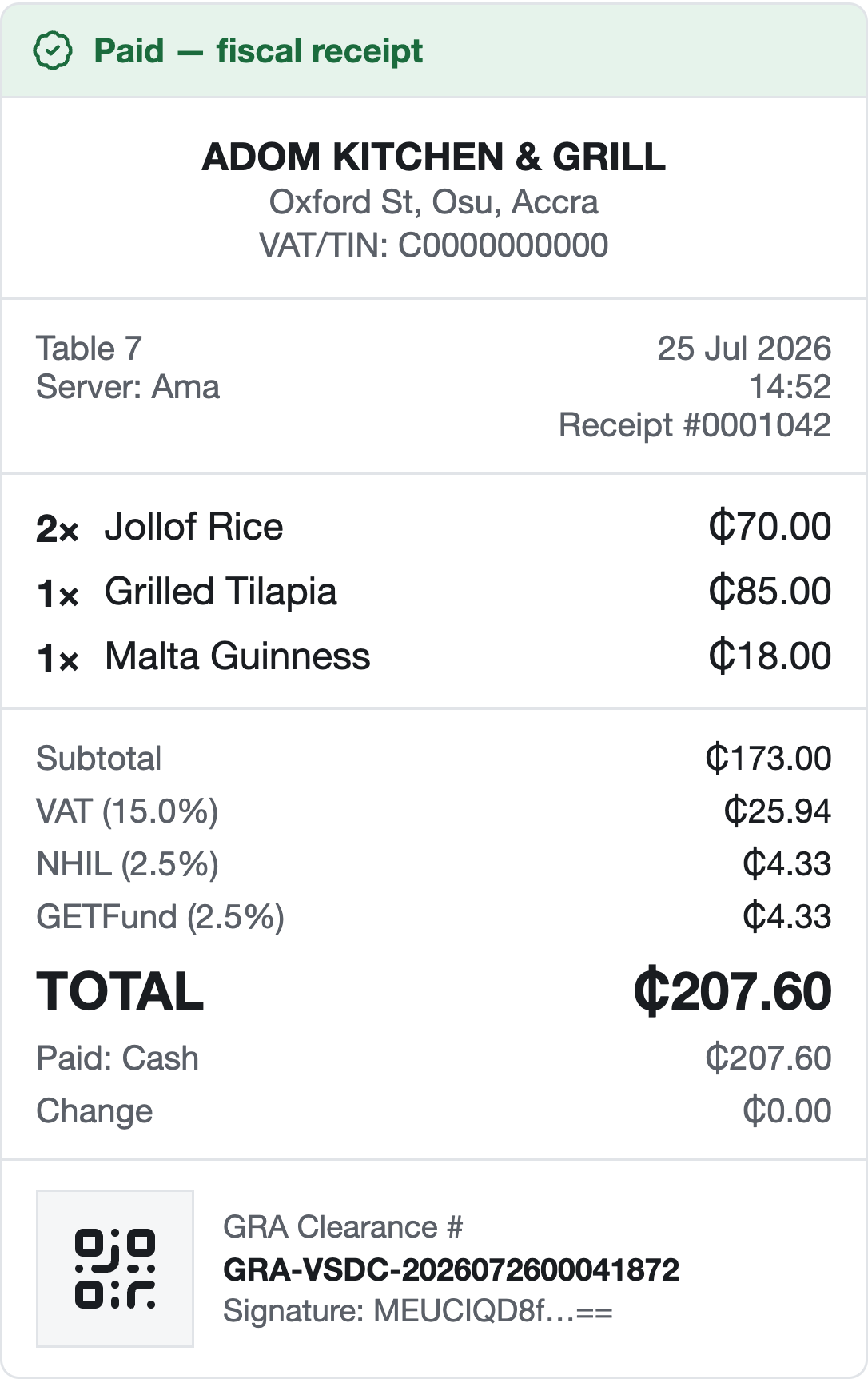
A restaurant receipt in Ghana carries more than a single tax figure. On top of the subtotal for food and drink, three separate levies apply: VAT at 15%, the National Health Insurance Levy (NHIL) at 2.5%, and the Ghana Education Trust Fund levy (GETFund) at 2.5%. Each one is calculated on the subtotal and should appear as its own line, not folded into a combined "tax" total: that itemization is exactly what a compliant, GRA E-VAT-oriented receipt is expected to show. A clearance reference and the amounts in cedis (₵) round out the slip.
Here's the arithmetic on a ₵100.00 subtotal, the same calculation Obali TableKare runs on every sale before it hits the printer:
| Line | Amount |
|---|---|
| Subtotal | ₵0.00 |
| VAT (15.0%) | ₵0.00 |
| NHIL (2.5%) | ₵0.00 |
| GETFund (2.5%) | ₵0.00 |
| Total | ₵0.00 |
₵15.00 in VAT, ₵2.50 in NHIL and ₵2.50 in GETFund, on top of the ₵100.00 subtotal, brings the total to ₵120.00. Run that same 15% / 2.5% / 2.5% stack on any subtotal and the itemized lines follow the same proportions.
What E-VAT means and where it's going in 2026
Ghana has been moving toward an electronic VAT system: digitally-signed receipts issued through certified devices, often described around VSDC (VAT Service Device Controller) style hardware and software, with a QR code on the slip that ties the sale back to the Ghana Revenue Authority. The direction is clear even where the exact mechanics and rollout timing are still settling: itemized, digitally-signed, verifiable receipts rather than a handwritten or loosely-formatted slip.
We're deliberately not pinning this page to a specific regulation number or a hard effective date, because that detail shifts as GRA guidance is published and updated. What's steady is the shape of where things are headed: restaurants should expect receipts to carry a clearance or signature reference alongside the VAT, NHIL and GETFund lines, and a POS worth using should already be structured to produce that kind of receipt rather than needing a rebuild later.
Obali TableKare is built for GRA E-VAT requirements. It is not GRA-certified or endorsed, and restaurants remain responsible for their own tax compliance: confirm requirements directly with the Ghana Revenue Authority.
This is one piece of a larger system: Obali TableKare is offline-first restaurant POS for Ghana, covering the till, kitchen display, QR ordering and stock control alongside receipts. Read more on what to check when choosing a restaurant POS built for Ghana, or see a receipt built in the demo with sample data.
Watch the tax lines calculate on a real sale.
Take a payment in the live demo and watch the VAT, NHIL and GETFund lines itemize on the printed slip, or join the pilot to bring it into your own restaurant.